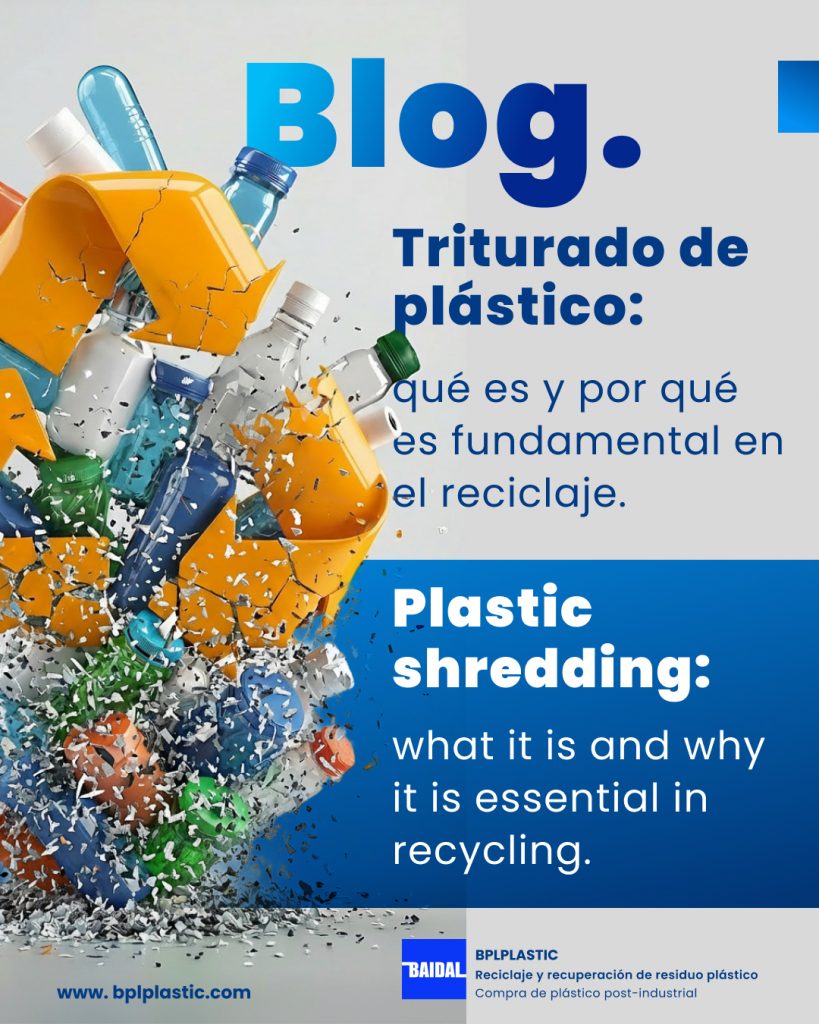
Plastic shredding: what it is and why it is essential in recycling

Plastic shredding: what it is and why it is essential in recycling

Plastic recycling is a key process in moving towards a more sustainable circular economy model.

Within this process, plastic shredding plays a fundamental role, as it allows waste to be transformed into reusable raw material for industry.

At Baidal Plastic, we have been working for decades on the recovery of post-industrial plastic, applying efficient processes that guarantee the quality of the recycled material and its reuse in new production cycles.

What is plastic shredding?

It is a phase of the recycling process in which plastic waste is reduced to small fragments.

This crushed material, known as granules, is usually presented in the form of small particles or homogeneous pellets.

This step is essential because:

  • It facilitates the handling of the material.
  • It allows for better cleaning and subsequent treatment.
  • Prepare the plastic for its transformation into new products.

In industrial plants, this process is carried out with specialized machinery capable of shredding the plastic into different sizes, usually between 8 and 12 mm, depending on the final use.

Shredding within the recycling process

It is not an isolated process, but rather part of a well-structured recycling chain.

In the case of post-industrial plastic recycling, the process usually includes the following phases:

  1. Selection and classification: separation of waste according to type of plastic.
  2. Crushing: reducing the material to granules.
  3. Washing: removal of impurities.
  4. Extrusion and filtration: transformation into new plastic material.

Shredding acts as a turning point, as it transforms bulky and difficult-to-manage waste into a uniform and reusable material.

Why is it so important?

1. Improves recycling efficiency

Reducing the size of the plastic allows for the optimization of all subsequent phases.

origin of plastic

A homogeneous material facilitates washing, drying and transformation, making the process faster and more efficient.

2. Guarantee the quality of the recycled material

One of the goals of industrial recycling is to maintain the properties of the original plastic.

In advanced processes, such as those applied by specialized companies, minimal physical alteration of the material is achieved, preserving its chemical characteristics.

Grinding is key to achieving the uniformity needed to obtain a high-quality final product.

3. Reduces logistics and storage costs

Shredded plastic takes up less space than the original waste.

This facilitates its transport, storage and handling, reducing operating costs for companies.

Furthermore, it allows for the more efficient management of large volumes of industrial waste.

4. Facilitates the circular economy

Shredding turns waste into resources.

Thanks to this process, materials that were previously waste can be reincorporated into the production chain.

This has a direct impact on:

  • Reducing the use of virgin raw materials.
  • Energy savings.
  • The reduction of waste in landfills.

In fact, the recycling of industrial plastic contributes significantly to reducing the consumption of resources such as oil and natural gas.

Applications of shredded plastic

The material obtained after crushing can be used to manufacture a wide variety of products, from industrial components to new packaging.

In the case of post-industrial plastic, its high purity allows it to be reused even in demanding production processes, closing the material’s life cycle without losing quality.

Plastic shredding is much more than a technical phase within recycling: it is a strategic process that allows waste to be transformed into opportunities.

Thanks to its ability to optimize material processing, improve quality, and facilitate reuse, shredding becomes a fundamental pillar for moving towards a more sustainable and efficient industry.

In a context where waste management is one of the great global challenges, investing in advanced recycling processes is not just an option, but a necessity for the future of the planet.

At Baidal Plastic we specialize in recycling and recovering plastic waste, as well as buying post-industrial plastic. Contact us.

Recycled plastic in today’s industry. The most innovative uses.

Recycled plastic has become a key resource for sustainable industry.

Leading companies in industrial recycling stand out for transforming post-industrial plastic waste into high-quality raw materials.

This promotes innovative applications ranging from engineering to fashion.

Recycled plastic in engineering and industrial manufacturing

Recycling industrial plastics allows the preservation of the original mechanical properties of materials such as PC, ABS or PP.

These materials are used in technical parts and structural components.

This provides businesses with:

  • Reduction of raw material costs.

  • Lower environmental impact and CO₂ emissions.

  • Sustainable material with high durability and resistance.

The incorporation of recycled plastic into industrial manufacturing processes is becoming increasingly common.

Thus becoming a viable and ecological alternative to virgin plastic.

Applications in sustainable construction

The green building sector uses recycled plastic to:

  • Thermal and acoustic insulating boards.

  • Corrosion-resistant pipes and fittings.

  • Prefabricated and sustainable urban furniture.

These materials contribute to green building certifications and comply with environmental standards.

Thus offering durable and responsible solutions for architects and builders.

Innovation in the automotive industry

Recycled plastic in the automotive industry reduces vehicle weight and emissions during manufacturing.

Among its applications, the following stand out:

  • Interior panels and cladding.

  • Non-visible structural components.

  • Supports and elements of light machinery.

More and more manufacturers are integrating high-quality recycled plastics into their vehicles.

In this way they combine sustainability and efficiency.

Fashion and sustainable products

Recycling PET and other plastics has opened the door to sustainable fashion and sports accessories.

Fibers derived from recycled plastics are used in:

  • High-performance sportswear.

  • Ecological footwear.

  • Reusable bags and backpacks.

This type of innovation shows how recycled plastic can be integrated into creative industries.

Promoting sustainability in everyday life.

Street furniture and consumer products

Recycled plastic is also used in street furniture such as:

  • Park benches and recreational areas.

  • Signage and acoustic coverings.

  • Components of household appliances and domestic packaging.

Their strength, durability and versatility mean that more and more companies are adopting solutions based on recycled plastics.

This promotes the circular economy.

Circular economy and sustainability

The greatest value of recycled plastic is its role in the circular economy.

It allows industrial waste to be transformed into reusable raw materials.

This reduces the need for fossil resources and decreases environmental pollution.

Recycled plastic is no longer just an alternative material: it has become an engine of industrial and sustainable innovation.

From engineering and construction to fashion and urban furniture, the applications are becoming increasingly diverse and sophisticated.

Adopting high-quality recycled plastics is essential for companies seeking efficiency, sustainability, and environmental commitment.


Recycled Plastic vs. Recyclable Plastic: What’s the Difference?

Plastic remains one of the most widely used and debated materials.

Terms like “recycled plastic” and “recyclable plastic” often cause confusion.

Although they sound similar, they do not mean the same thing and have very different implications for the environment.

If you want to better understand these concepts and how they affect our consumer decisions, continue reading our blog.

What is Recyclable Plastic?

Recyclable plastic is plastic that has the potential to be recycled.

That is, it can be processed to become a new product or material.

However, just because a plastic is recyclable does not guarantee that it will actually be recycled.

Some factors that influence its recyclability include:

Plastic type:

Not all plastics are equally recyclable.

The most commonly recycled are PET (water bottles) and HDPE (detergent containers).

Recycling infrastructure:

If there are no adequate recycling centers or if plastic is not collected effectively, it will end up in landfills or in the environment.

Cleaning conditions:

Plastics that are dirty or contaminated with food residue, oil, or other materials may be rejected by recycling plants.

🔹 Examples of recyclable plastics:

Soft drink bottles (PET), milk containers (HDPE), yogurt containers (PP), some packaging plastics.

What is Recycled Plastic?

Recycled plastic is plastic that has already gone through a recycling process and has been reused to make new products.

That is, it is not only recyclable, but it has already been recycled and turned into something new.

Using recycled plastic has important benefits, such as:

♻️ Reduction in the use of virgin plastic

Demand for oil and other natural resources used to make new plastic is decreasing.

♻️ Less waste in landfills and oceans

Help reduce the amount of plastic that ends up polluting the planet.

♻️ Smaller carbon footprint

The manufacturing process with recycled plastic typically requires less energy than producing new plastic.

🔹 Examples of recycled plastic:

Clothing made from recycled PET bottles, street furniture made from recycled plastic, and packaging that indicates it has been manufactured with “X% recycled material.”

Which is Better for the Environment?

The answer depends on several factors, but generally speaking, recycled plastic has a more positive environmental impact than recyclable plastic.

  • Recyclable plastic that isn’t recycled ends up in landfills or the ocean, where it can take hundreds of years to degrade.

  • Recycled plastic has already been reused, reducing the need to produce more virgin plastic.

However, recycling is not the only solution.

It’s also essential to reduce the use of single-use plastics and promote more sustainable alternatives, such as biodegradable or reusable packaging.

Although the terms “recycled plastic” and “recyclable plastic” may seem similar, they have key differences.

A recyclable plastic has the potential to be recycled, but this depends on factors such as recycling infrastructure and cleaning.

On the other hand, recycled plastic has already been processed and reused, which reduces its environmental impact.

To contribute to a more sustainable world, it’s not enough to simply choose recyclable plastics.

We must ensure that they are actually recycled and encourage the use of recycled materials.

Furthermore, the best option will always be to reduce the consumption of unnecessary plastics and opt for more environmentally friendly alternatives.

Benefits of recycling post-industrial plastic

Recycling plastic is one of the most effective strategies to reduce pollution and promote sustainability in the industry.

Post-industrial plastic has become a key resource for many companies seeking to minimize their environmental impact and optimize their production processes.

In today’s blog we talk about the main benefits of recycling post-industrial plastic and its importance for the future of the planet.

What is post-industrial plastic?

Post-industrial plastic (PIR) comes from waste generated in factories and manufacturing processes before products reach the final consumer.

post-industrial plastic

Unlike post-consumer plastic, which is recycled after it has been used, post-industrial plastic is easier to recover because it has not been contaminated with other materials.

Examples of post-industrial plastic include:

  • Manufacturing offcuts and scrap.
  • Defective or surplus materials.
  • Mold and extrusion residues in production.

Reducing waste in landfills

One of the main benefits of recycling post-industrial plastic is the reduction of waste ending up in landfills.

The industry generates tons of plastic every day.

And if these materials are not recycled, they can take hundreds of years to decompose.

By recycling this waste, landfills are not saturated and environmental pollution is reduced.

In addition, greenhouse gas emissions associated with the decomposition of plastic in unsuitable environments are reduced.

Saving natural resources

Plastic is primarily made from petroleum and natural gas.

These resources are non-renewable and their extraction and processing have a high environmental impact.

Post-industrial plastic recycling allows existing materials to be reused, reducing the demand for new raw materials.

This not only contributes to the conservation of natural resources, but also reduces energy consumption in the production of new plastics.

Lower energy consumption in production

Recycling post-industrial plastic requires less energy compared to manufacturing virgin plastic.

According to various studies, the use of recycled plastic in production can reduce energy consumption by up to 70% in some cases.

Lower energy consumption means:
– Lower costs for companies.
– Less dependence on fossil fuels.
– Less carbon emissions in the production process.

Promoting the circular economy

Recycling post-industrial plastic is a key practice within the circular economy.

A model that seeks to reduce waste and extend the useful life of materials.

Instead of throwing away plastics after their initial use, companies can reintroduce them into the production cycle, creating a more efficient and sustainable system.

This generates multiple economic and environmental benefits, such as:

  • Reduction of production costs.
  • Creation of new business models based on reuse.
  • Greater independence from virgin raw materials.

Compliance with environmental regulations

More and more governments and international organizations are imposing strict regulations on the management of plastic waste.

Companies that implement post-industrial plastic recycling can comply with environmental regulations.

And in this way, avoid sanctions or taxes related to pollution.

Additionally, many companies that recycle plastic can obtain sustainability certifications.

Which improves their reputation and makes them more attractive to customers and business partners.

Innovation in new recycled materials

Post-industrial plastic recycling drives innovation in the industry, enabling the development of high-quality recycled materials.

Nowadays, there are recycled plastics that retain the same mechanical and chemical properties as virgin plastics, allowing their use in sectors such as:

  • Automotive
  • Sustainable packaging.
  • Construction
  • Textile industry (recycled synthetic fabrics).

Thanks to these advances, recycled plastic has become a viable and efficient alternative in many industrial sectors.

Improvement of corporate image

Companies that implement recycling and sustainability policies gain consumer preference.

In a world where environmental awareness is on the rise, brands that opt ​​for recycled materials can strengthen their reputation and differentiate themselves from the competition.

Consumers increasingly value companies that are committed to the environment, which translates into greater loyalty and trust in the brand.

Recycling post-industrial plastic is not only a sustainable practice, but also provides economic, energy and strategic benefits for companies.

From reducing waste to saving resources and complying with regulations, this process is key to moving towards a more circular and efficient economy.

The industry has the opportunity to transform recycling into a competitive advantage by adopting innovative technologies and promoting responsible practices.

The future of plastic depends on how we manage it today, and post-industrial recycling is a big step in the right direction.