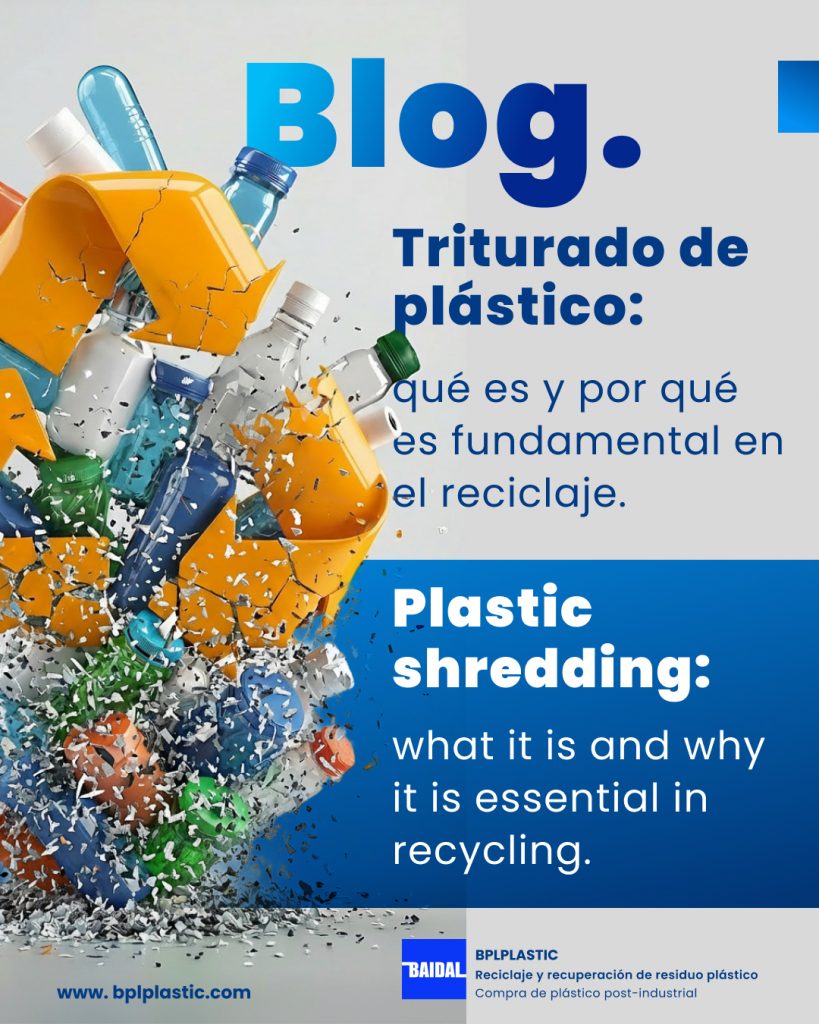
Plastic shredding: what it is and why it is essential in recycling
Plastic recycling is a key process in moving towards a more sustainable circular economy model.
Within this process, plastic shredding plays a fundamental role, as it allows waste to be transformed into reusable raw material for industry.
At Baidal Plastic, we have been working for decades on the recovery of post-industrial plastic, applying efficient processes that guarantee the quality of the recycled material and its reuse in new production cycles.
What is plastic shredding?
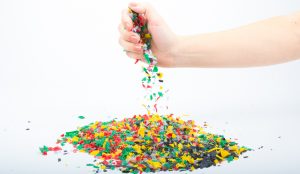
It is a phase of the recycling process in which plastic waste is reduced to small fragments.

This crushed material, known as granules, is usually presented in the form of small particles or homogeneous pellets.
This step is essential because:
- It facilitates the handling of the material.
- It allows for better cleaning and subsequent treatment.
- Prepare the plastic for its transformation into new products.
In industrial plants, this process is carried out with specialized machinery capable of shredding the plastic into different sizes, usually between 8 and 12 mm, depending on the final use.
Shredding within the recycling process
It is not an isolated process, but rather part of a well-structured recycling chain.
In the case of post-industrial plastic recycling, the process usually includes the following phases:
- Selection and classification: separation of waste according to type of plastic.
- Crushing: reducing the material to granules.
- Washing: removal of impurities.
- Extrusion and filtration: transformation into new plastic material.
Shredding acts as a turning point, as it transforms bulky and difficult-to-manage waste into a uniform and reusable material.
Why is it so important?
1. Improves recycling efficiency
Reducing the size of the plastic allows for the optimization of all subsequent phases.

A homogeneous material facilitates washing, drying and transformation, making the process faster and more efficient.
2. Guarantee the quality of the recycled material
One of the goals of industrial recycling is to maintain the properties of the original plastic.
In advanced processes, such as those applied by specialized companies, minimal physical alteration of the material is achieved, preserving its chemical characteristics.
Grinding is key to achieving the uniformity needed to obtain a high-quality final product.
3. Reduces logistics and storage costs
Shredded plastic takes up less space than the original waste.
This facilitates its transport, storage and handling, reducing operating costs for companies.
Furthermore, it allows for the more efficient management of large volumes of industrial waste.
4. Facilitates the circular economy
Shredding turns waste into resources.
Thanks to this process, materials that were previously waste can be reincorporated into the production chain.
This has a direct impact on:
- Reducing the use of virgin raw materials.
- Energy savings.
- The reduction of waste in landfills.
In fact, the recycling of industrial plastic contributes significantly to reducing the consumption of resources such as oil and natural gas.
Applications of shredded plastic
The material obtained after crushing can be used to manufacture a wide variety of products, from industrial components to new packaging.
In the case of post-industrial plastic, its high purity allows it to be reused even in demanding production processes, closing the material’s life cycle without losing quality.
Plastic shredding is much more than a technical phase within recycling: it is a strategic process that allows waste to be transformed into opportunities.
Thanks to its ability to optimize material processing, improve quality, and facilitate reuse, shredding becomes a fundamental pillar for moving towards a more sustainable and efficient industry.
In a context where waste management is one of the great global challenges, investing in advanced recycling processes is not just an option, but a necessity for the future of the planet.
At Baidal Plastic we specialize in recycling and recovering plastic waste, as well as buying post-industrial plastic. Contact us.


