Ecological footprint. Tips to reduce it in our daily lives

Reducing our ecological footprint is possible without great sacrifices, simply by incorporating more conscious and sustainable habits into our daily routine.

Concern for the environment is no longer a passing trend, but a real necessity.

Every decision we make in our daily lives has a direct impact on the planet, from the products we buy to the way we get around or manage waste.

In this month’s blog post, we’ll give you some tips on how to reduce your ecological footprint.

Why is it important to reduce our ecological footprint?

The ecological footprint measures the impact that our activities have on natural resources.

Excessive consumption of energy, water, or materials leads to greater exploitation of the planet, accelerating problems such as climate change, loss of biodiversity, and waste accumulation.

Reducing it means living more responsibly, ensuring that future generations can enjoy a healthy environment.

Consume responsibly

One of the first steps to reducing our ecological footprint is to rethink our consumption habits.

ecological footprint

Buying only what is necessary, prioritizing durable products, and choosing quality over quantity helps to reduce the demand for resources.

Furthermore, choosing brands committed to sustainability and the circular economy has a positive effect on the entire production chain.

Reduce your use of unnecessary plastics

Single-use plastic is one of today’s major environmental challenges.

Replacing disposable bags, bottles, or containers with reusable alternatives significantly reduces waste generation.

Whenever possible, choose recyclable products or products made from recycled materials, thus promoting a more sustainable consumption model.

Save energy at home

Domestic energy consumption represents a significant part of our ecological footprint.

Small actions such as turning off lights when not in use, taking advantage of natural light, using efficient appliances, or properly regulating heating and air conditioning can lead to significant energy savings.

Additionally, unplugging devices in standby mode helps reduce invisible electricity consumption.

Use water responsibly

Water is a limited and essential resource.

Reducing shower time, turning off the tap while brushing your teeth, or using appliances with low-consumption programs are simple gestures that make a difference.

It is also advisable to reuse water whenever possible, for example, for watering plants.

Commit to more sustainable mobility

Transportation is one of the main sources of polluting emissions.

Whenever possible, it is preferable to walk, cycle or use public transport.

Carpooling, better planning of journeys or opting for more efficient vehicles also helps to reduce CO₂ emissions and the consumption of fossil fuels.

Reduce and properly separate waste

Applying the rule of reduce, reuse and recycle remains essential.

Properly separating waste makes it easier to recycle and prevents it from ending up in landfills or the natural environment.

In addition, giving a second life to objects or materials before discarding them helps to reduce the amount of waste generated.

Incorporate sustainable habits into your daily life

Beyond specific actions, adopting a sustainable mindset is key.

Getting informed, educating those around us, and being aware of the impact of our decisions helps create real and lasting change.

Every little gesture counts when it adds up to the collective effort.

A commitment to the future

Reducing our ecological footprint does not require radical changes, but rather consistency and commitment.

At Baidal Plastic we believe in the importance of moving towards more responsible models, opting for solutions that promote sustainability and the efficient use of resources.

Incorporating these tips into your daily life is a firm step towards a future that is more respectful of the environment and people.
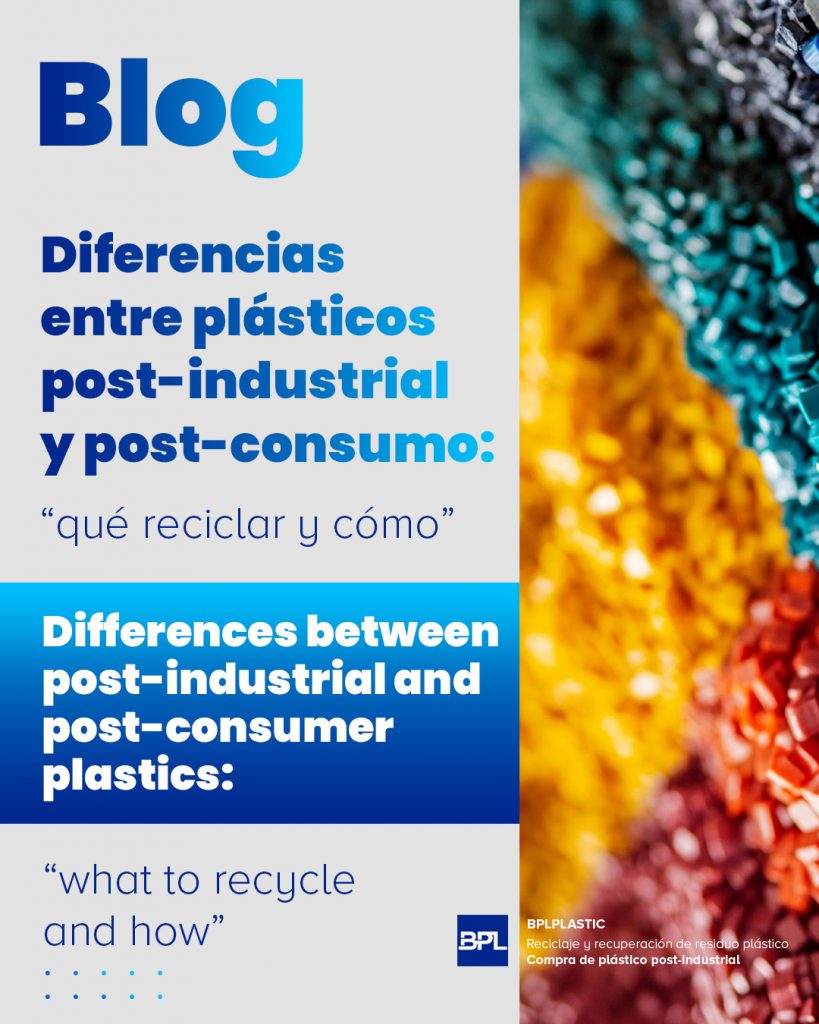

 

Differences between post-industrial and post-consumer plastics: what to recycle and how

When we talk about recycled plastic, two terms frequently appear that are important to understand: post-industrial and post-consumer.

Although both are essential to reducing environmental impact, they do not mean the same thing.

Understanding their differences helps in deciding which materials to use and how to manage them correctly in industrial projects or at home.

In today’s blog post we explain what each one is.

What is post-industrial plastic?

Post-industrial plastic comes from the waste generated during production processes.

This includes offcuts, rejected parts, extrusion or injection surpluses that did not reach the market or the end consumer.

Since it has not been used by people, this material is usually more homogeneous and cleaner.

This facilitates their reintegration into the manufacture of new parts.

This facilitates their reintegration into the manufacture of new parts.

What is post-consumer plastic?

Post-consumer plastic comes from packaging, products, and waste that have already been used by consumers.

After passing through selective collection systems, these materials are sorted and prepared for recycling.

The main advantage of post-consumer plastic is that it truly closes the circular economy loop.

Transforming used materials into new products.

However, because it comes from different origins and uses, it may be more contaminated or mixed with other types of plastic.

Therefore, it requires more complex cleaning and sorting processes.

Advantages and limitations of each type of recycled plastic

Post-industrial plastic offers uniformity and traceability, since its origin and exact composition are known.

This makes it ideal for industrial applications where consistency and controlled quality are required.

Post-consumer plastic, on the other hand, provides environmental credentials and is preferred by companies that want to demonstrate a commitment to sustainability and comply with recycling regulations.

Their main challenge is the need for more careful processes to achieve quality standards similar to new or post-industrial plastic.

In terms of application, post-industrial is usually used in technical or industrial parts, while post-consumer is used both in packaging and in products where sustainability is an added value.

The choice between one or the other depends on the type of project, the traceability requirement, and the applicable regulations.

What to recycle and how to do it

For consumers, properly separating plastics is key.

Washing containers, removing food scraps, and sorting materials by type facilitates recycling and improves the quality of post-consumer material.

It is advisable to avoid multi-layered, glittery or metallized plastics, which hinder the recycling process.

In the industrial sector, post-industrial waste must be handed over to specialized managers.

These professionals ensure that the surplus materials are processed efficiently and safely, transforming them into new recycled material suitable for manufacturing.

In addition, before recycling, it is always helpful to consider reuse.

Bags, boxes, tapes, and other materials can have multiple lives if used consciously, thus reducing the amount of plastic that needs to be recycled.

Quality, traceability and certifications

For projects that demand strict quality standards, such as the food or automotive sector, it is essential to have suppliers that offer traceability and recognized certifications.

These certifications ensure that the recycled plastic meets the necessary technical and regulatory requirements and provide security for both manufacturers and consumers.

Not all recycled plastics are the same.

Post-industrial material is more uniform and easier to process.

While post-consumer waste closes the real circular economy cycle, it does require greater care in its separation and cleaning.

The choice between one or the other will depend on the end use, quality requirements, and legal obligations.

In both industry and at home, small decisions in plastic management can have a big impact on sustainability and the future of the planet.

At Baidal, we supply all types of recycled plastic materials to manufacturers of plastic products. Our plastic is free of impurities, of post-industrial origin, and comes with a quality guarantee.

Consult with us.

Facts about industrial plastic recycling that will surprise you

Industrial plastic recycling is a key component in moving toward a sustainable circular economy.

In today’s blog, we discuss data that demonstrates the importance and challenges of this process in the industrial sector.

Spain, a European benchmark with real industrial capacity

Spain leads Europe in installed plastics recycling capacity, with more than 2.2 million tons per year.

Ranked second after Germany and notable for its population per capita.

This industrial infrastructure is crucial for transforming waste into valuable resources within the industry.

Growing domestic recycling: indirect injection into industry

Although the focus is industrial, domestic recycling influences the demand for recycled raw materials.

In 2024, Ecoembes managed the recycling of more than 1.56 million tons of household packaging.

A historic record that represents 5.4% growth compared to 2023.

A historic record that represents 5.4% growth compared to 2023.

These figures demonstrate a social commitment that fuels the industrial recycling cycle.

Sectoral innovation and sustainability on the rise

The Spanish Plastics Industry Strategy strengthens the use of recycled plastic, eco-design, and decarbonization through electrification and renewable energy.

Furthermore, it stands out for promoting both mechanical and chemical processes, and is committed to traceability through technologies such as blockchain.

At the 4th ANARPLA Congress, an installed recycling capacity of 2,227 kt was reported, managed by 160 companies and 185 active facilities.

Government impetus and citizen awareness

Despite progress, the yellow container shows persistent difficulties.

In 2023, only 41.3% of plastic bottles were recycled, well below the target of 70% by 2025.

This reinforces the need for a deposit, return, and refund system (DRRS).

Facts to keep in mind regarding industrial plastic recycling

  • Actual capacity:

Spain not only has the capacity, it is using it.

  • Cutting-edge technology:

Projects like pyrolysis in Huelva represent a leap forward in chemical recycling and the recovery of difficult-to-use plastics.

  • Volume on the rise:

Domestic recycling continues to grow, generating more recycled raw materials to re-enter production processes.

  • Strategic drive:

The national strategy, with investments in R&D&I and sustainability, consolidates an industrial vision aligned with climate neutrality.

  • Education and legislation united:

Innovations such as reward systems and the possible implementation of the SDDR reflect an evolving dynamic, where citizenship and politics mutually reinforce each other.

Positive impact of industrial plastic recycling

Energy savings and reduction of raw materials

Using recycled plastic means less oil and natural gas consumption and requires less energy than producing it from scratch.

Quality of post-industrial plastic

Post-industrial plastic is usually highly pure and suitable for reincorporation into the same production process or transformation into new products.

Thus avoiding unnecessary waste.

Circular economy and pollution reduction

Reusing industrial plastics promotes the circular economy and drastically reduces the environmental impact of waste.

Challenges and solutions to promote industrial plastic recycling

  • Material contamination:

The presence of impurities makes recycling difficult.

Implementing source separation strategies is crucial.

  • High logistics and technological costs:

The complexity of transportation and storage raises prices.

Optimizing the logistics chain and taking advantage of incentives can make all the difference.

  • Variability in the properties of recycled material:

This limits its use in demanding processes.

However, new bio-inspired designs are reducing this variability by up to 90%.

  • Insufficient regulation and eco-design:

Promoting clear standards and sustainable design practices would allow for a qualitative leap in industrial recycling.

Industrial plastic recycling has the potential to transform the plastics industry, generating environmental and economic benefits.

However, achieving a circular economy requires addressing technical, logistical, and regulatory challenges.

At Baidal, we believe that reporting with solid data is the first step in driving change.


Benefits of recycling post-industrial plastic

Recycling plastic is one of the most effective strategies to reduce pollution and promote sustainability in the industry.

Post-industrial plastic has become a key resource for many companies seeking to minimize their environmental impact and optimize their production processes.

In today’s blog we talk about the main benefits of recycling post-industrial plastic and its importance for the future of the planet.

What is post-industrial plastic?

Post-industrial plastic (PIR) comes from waste generated in factories and manufacturing processes before products reach the final consumer.

post-industrial plastic

Unlike post-consumer plastic, which is recycled after it has been used, post-industrial plastic is easier to recover because it has not been contaminated with other materials.

Examples of post-industrial plastic include:

  • Manufacturing offcuts and scrap.
  • Defective or surplus materials.
  • Mold and extrusion residues in production.

Reducing waste in landfills

One of the main benefits of recycling post-industrial plastic is the reduction of waste ending up in landfills.

The industry generates tons of plastic every day.

And if these materials are not recycled, they can take hundreds of years to decompose.

By recycling this waste, landfills are not saturated and environmental pollution is reduced.

In addition, greenhouse gas emissions associated with the decomposition of plastic in unsuitable environments are reduced.

Saving natural resources

Plastic is primarily made from petroleum and natural gas.

These resources are non-renewable and their extraction and processing have a high environmental impact.

Post-industrial plastic recycling allows existing materials to be reused, reducing the demand for new raw materials.

This not only contributes to the conservation of natural resources, but also reduces energy consumption in the production of new plastics.

Lower energy consumption in production

Recycling post-industrial plastic requires less energy compared to manufacturing virgin plastic.

According to various studies, the use of recycled plastic in production can reduce energy consumption by up to 70% in some cases.

Lower energy consumption means:
– Lower costs for companies.
– Less dependence on fossil fuels.
– Less carbon emissions in the production process.

Promoting the circular economy

Recycling post-industrial plastic is a key practice within the circular economy.

A model that seeks to reduce waste and extend the useful life of materials.

Instead of throwing away plastics after their initial use, companies can reintroduce them into the production cycle, creating a more efficient and sustainable system.

This generates multiple economic and environmental benefits, such as:

  • Reduction of production costs.
  • Creation of new business models based on reuse.
  • Greater independence from virgin raw materials.

Compliance with environmental regulations

More and more governments and international organizations are imposing strict regulations on the management of plastic waste.

Companies that implement post-industrial plastic recycling can comply with environmental regulations.

And in this way, avoid sanctions or taxes related to pollution.

Additionally, many companies that recycle plastic can obtain sustainability certifications.

Which improves their reputation and makes them more attractive to customers and business partners.

Innovation in new recycled materials

Post-industrial plastic recycling drives innovation in the industry, enabling the development of high-quality recycled materials.

Nowadays, there are recycled plastics that retain the same mechanical and chemical properties as virgin plastics, allowing their use in sectors such as:

  • Automotive
  • Sustainable packaging.
  • Construction
  • Textile industry (recycled synthetic fabrics).

Thanks to these advances, recycled plastic has become a viable and efficient alternative in many industrial sectors.

Improvement of corporate image

Companies that implement recycling and sustainability policies gain consumer preference.

In a world where environmental awareness is on the rise, brands that opt ​​for recycled materials can strengthen their reputation and differentiate themselves from the competition.

Consumers increasingly value companies that are committed to the environment, which translates into greater loyalty and trust in the brand.

Recycling post-industrial plastic is not only a sustainable practice, but also provides economic, energy and strategic benefits for companies.

From reducing waste to saving resources and complying with regulations, this process is key to moving towards a more circular and efficient economy.

The industry has the opportunity to transform recycling into a competitive advantage by adopting innovative technologies and promoting responsible practices.

The future of plastic depends on how we manage it today, and post-industrial recycling is a big step in the right direction.

Recycling plastics in the food sector: challenges and solutions

Plastic recycling in the food sector has become an important issue in the sustainability debate. As environmental awareness grows and regulations tighten, the food industry is looking to reduce its ecological footprint. Here, plastic management plays a key role. This sector faces a number of specific challenges that must be overcome in order to meet societal and regulatory expectations. In today’s blog, we discuss the main challenges facing plastic recycling in the food industry, as well as some of the solutions that are already in place to improve the situation.

The challenges of plastic recycling in the food sector

Pollution and food safety

One of the main obstacles to recycling plastics in the food sector is the strict regulations related to food safety.

Plastic packaging that has been in contact with food must meet high standards of purity to avoid contamination. This means that even if plastic can be recycled, it is not always possible to reuse it to make new food packaging. Especially if the recycled material does not guarantee the necessary safety or quality. Recycled plastics that contain food residues or that have absorbed chemicals during their life cycle can become a source of contamination. The recycling process must therefore be extremely rigorous. This increases the costs and complexity of the process.

Complexity of plastic materials

The food industry uses a wide variety of plastic types, from PET (polyethylene terephthalate) for bottles and rigid containers, to low-density polyethylene (LDPE) for bags and packaging.

Each type of plastic requires a specific recycling process, which complicates waste management and sorting. In addition, many food products come in composite packaging, which combines several types of plastics or even other materials such as paper or aluminium. These multi-layer materials are particularly difficult to recycle, as separating them efficiently is expensive and technologically complex.

Low effective recycling rate

Although plastic recycling in general has increased in recent years, the effective recycling rate for plastics in the food sector remains low. This is because many consumers do not separate properly.

Limited infrastructure

Although technologies exist to recycle plastics, the infrastructure available to carry out this process on a global scale remains limited.

Many recycling plants are not equipped to process food-grade plastics, which reduces recycling rates in the sector.

Solutions for recycling plastics in the food sector

New technological and strategic solutions are emerging to address this problem more effectively:

Chemical recycling

Chemical recycling is one of the most promising solutions. Unlike mechanical recycling, which can only reprocess relatively high-quality plastics, chemical recycling breaks down plastics into their basic chemical components, allowing them to be reconverted into virgin materials.

Biodegradable and compostable plastics

Biodegradable and compostable plastics are gaining ground in the food sector.

Although they are not a direct solution to recycling, they can alleviate the burden of plastic waste, if properly managed in industrial composting infrastructures.

Ecodesign for recyclability

Companies are adopting eco-design to create plastic packaging that is easier to recycle. This includes reducing composite materials that are difficult to separate and eliminating inks and adhesives that contaminate the recycling stream. Eliminating plastic in the food sector is practically impossible today. That is why we must look for alternatives that facilitate its recycling or reuse.

Challenges and Solutions in Post-Industrial Plastic Recycling

Post-industrial plastic recycling is an important topic in the context of sustainability and the circular economy.

Companies that produce or use large quantities of industrial plastics face the challenge of managing waste responsibly.

However, the recycling process of these plastics is not without difficulties. In today’s article we talk about the main challenges that companies face in recycling post-industrial plastics.

What is post-industrial plastic?

Post-industrial plastic refers to plastic waste generated during the manufacturing of products.


These wastes can include leftover materials, production defects, production surpluses, and other byproducts of the industrial process.

Unlike post-consumer plastic, which comes from products discarded by consumers, post-industrial plastic has not been used in its final form.

Therefore, it often has a higher recycling value.

Challenges in recycling post-industrial plastics

1. Material contamination

One of the biggest challenges in post-industrial plastic recycling is material contamination.

During the manufacturing process, plastics can become contaminated with residues from other materials.

This contamination can make efficient recycling difficult.

This is because contaminated materials cannot be processed effectively and may compromise the quality of the recycled product.

Solution: To address this problem, companies must implement rigorous sorting and cleaning processes at the initial recycling stage.

Using advanced separation technologies, such as density separation or optical sorting, can help reduce material contamination and improve the purity of recycled plastic.

2. Diversity of plastic types

Another important challenge is the diversity of types of plastic that are generated in industrial processes.

There are numerous types of plastics, each with different properties and recycling requirements. Mixing different types of plastics can complicate the recycling process and reduce the quality of the final product.

Solution: Companies must invest in sorting plastics at the source. Identifying and separating different types of plastics during the production process can facilitate subsequent recycling.

Additionally, working with recycling providers who have experience managing different types of plastics is crucial to ensuring an efficient process.

3. Recycling costs

Recycling post-industrial plastics can be expensive, especially if the implementation of new technologies or additional processes is required.


Costs may include investment in machinery, staff training, and management of non-recyclable waste.

Solution: Companies can reduce recycling costs by optimizing production processes to minimize waste.

Adopting design practices for recycling, such as using recyclable materials and simplifying product composition, can reduce the amount of waste generated and therefore recycling costs.

Additionally, exploring tax incentives or government subsidies for recycling can help mitigate costs.

4. Complexity in logistics

The logistics of post-industrial plastics recycling also present significant challenges.

Collecting, transporting and storing large volumes of plastic waste can be complicated and expensive. Additionally, the need to ensure that plastics are transported and stored in a way that prevents contamination or deterioration adds an additional layer of complexity.

Solution: Implementing efficient and sustainable logistics is key to overcoming this challenge.

Companies can work with logistics partners specialized in plastic waste management to optimize transportation routes, reduce costs and minimize environmental impact.

Additionally, implementing temporary storage systems at facilities can help better manage waste streams prior to recycling.

Post-industrial plastic recycling is essential to reduce the environmental impact of industrial waste and promote a circular economy.

Overcoming these challenges requires a strategic approach and investment in technology, logistics and staff training.

By adopting effective solutions, companies can not only improve their recycling efficiency, but also contribute to a more sustainable future.

Recycling post-industrial plastics is not an easy task. But with the right strategies, companies can overcome obstacles and take advantage of both the economic and environmental benefits that this process offers.

The importance of environmental education in plastic recycling

The importance of environmental education in plastic recycling

Plastic has become an omnipresent material in our daily lives.

From food packaging to toys, its versatility makes it indispensable in many industries.

However, this convenience comes at a high cost to our environment.

In today’s blog we talk about the importance of environmental education in plastic recycling.

What’s the ambiental education?

Environmental education refers to the process of awareness, understanding and action aimed at preserving and improving the environment.

In the context of plastic recycling, this involves educating people about the negative effects of plastic on the environment.

Likewise, the importance of reducing, reusing and recycling these materials to minimize their impact.

One of the key aspects of environmental education in plastic recycling is raising awareness about the environmental problems we face due to plastic pollution.

By educating people about these types of challenges, they are motivated to take steps to reduce their plastic consumption and increase their recycling efforts.

What teaches us?

Environmental education can provide us with all the relevant information regarding plastic recycling and how to do it correctly.

This includes learning how to properly separate different types of plastic, cleaning packaging before disposing of it, and knowing where it can be recycled, among other things.

Environmental education also provides us with knowledge about the negative impacts of plastic on the environment.

Many people are not aware of the time it takes for plastic to degrade, which can be hundreds or even thousands of years.

There are even many people who are unaware of the consequences it has on marine life and our own health.

By understanding these issues, we are more motivated to take action to reduce plastic consumption and recycle appropriately.

How to apply it?

It is essential to teach how to recycle correctly.

The vast majority of towns and cities have recycling systems.

But in many cases we do not know which plastics are recyclable and which are not, for example.

In that case, people can be taught to identify recycling codes on plastic packaging and separate them properly before throwing them away.

In addition, cleaning plastic containers before recycling them helps avoid contamination of other materials.

This facilitates the recycling process.

Information campaigns on environmental education have been carried out in many schools.

In these campaigns, the little ones were taught basic plastic recycling tips.

By integrating environmental education into the school curriculum, children can be taught about the environmental problems caused by plastic and how they can contribute to solving them.

Additionally, plastic collection programs can be established in schools.

In this way, students learn to separate and recycle materials correctly.

This learning acquired since they were children will surely make them continue with this habit for the rest of their lives.

Public awareness campaigns are also routinely carried out to promote plastic recycling.

These campaigns can use media, social networks and different types of events.

This can spread information about the benefits of recycling and provide guidance on how to do it correctly.

For example, there are campaigns focused on reducing the use of single-use plastic bags, encouraging the use of reusable or biodegradable bags.

The impact of environmental education on the circular economy

Another important aspect of environmental education in plastic recycling is its impact on the circular economy.

By educating children about the importance of recycling, the idea that plastic materials have value even after their initial use is encouraged.

This can boost demand for recycled products, thus promoting a more sustainable cycle of production and consumption.

There is no planet B to flee to when ours is exhausted.

Therefore, we must raise awareness among new generations about the importance of plastic recycling practices.

Environmental education is essential for this awareness.

At Baidal we encourage you to promote plastic recycling 🙂


Life after recycling: surprising recycled products

Plastic recycling is one of our great allies in the fight against pollution and climate change.

And the data tells us that we recycle more and better every time.

Thanks to this, a world of possibilities has opened up to give new life to discarded materials.

In today’s blog we will discover some recycled products that show us that life after recycling can be very innovative.

1. Sustainable Furniture

For some time now, recycled plastic has become a very popular material for manufacturing furniture.

Many companies in the sector have developed techniques to convert plastic bottles, for example, into tables and structures that are used in the creation of all types of furniture.

These furniture contribute to reducing the demand for wood and other non-renewable resources, in addition to being aesthetically attractive.

2. Environmentally Conscious Clothing

Sustainable fashion is gaining ground, and recycled plastic has become a widely used option for clothing manufacturing.

Clothing made from recycled plastic fibers not only reduces the amount of plastic waste in landfills, but also decreases reliance on virgin materials and the associated carbon footprint.

3. Educational and Fun Toys

Toys made from recycled plastic are a unique opportunity to teach children the importance of recycling from a young age.

We can now find puzzles, building blocks and educational toys made with recycled plastic in stores.

Toys that convey a positive message about environmental responsibility.

4. Sustainable Footwear

The footwear industry has embraced the recycled plastic trend, creating sneakers and sneakers that combine style with sustainability.

Some brands use recycled plastic bottles to make the uppers of their shoes.

Thus demonstrating that fashion and environmental responsibility can go hand in hand.

5. Eco-Friendly Technology

Electronics made from recycled plastic have gained popularity in the search for sustainable alternatives.

From phone cases to computer accessories, recycled products reduce the need for new materials.

And they also promote environmental awareness among technology consumers.

This shows us that life after recycling is not only possible, but also creative.

Innovation in the manufacturing of recycled products is changing the way we view discarded materials.

Recycled plastic is finding its way into a wide variety of products, offering environmental solutions and very valid opportunities for a more sustainable future.

By continuing to support recycling and opting for recycled products, each of us can contribute to this positive change and make life after recycling a reality.


Upcycled Art. Waste turned into art

In a world increasingly aware of the importance of sustainability and waste management, Upcycled Art has emerged as a great artistic expression.

It not only inspires through its beauty, but also contributes positively to the environment.

Upcycled Art is an artistic practice that focuses on the transformation of discarded or unused materials into unique and meaningful works of art.

In this article, we tell you what it consists of and its advantages from the point of view of waste and recycling management.

What is Upcycled Art?

Upcycled Art is based on the principle of giving new life to objects and materials that would otherwise be considered trash.

Unlike conventional recycling, which involves the decomposition of materials for reuse in similar products, upcycling transforms these materials into something new and original, preserving their original essence.

Upcycled artists explore the beauty of the unusual and the old-fashioned.

They look for a new narrative from apparently useless objects.

Advantages of Upcycled Art

Upcycled Art offers numerous advantages in the field of waste management and recycling:

Waste Reduction:

By reusing discarded objects and materials, Upcycled Art contributes to the reduction of waste in landfills.

In addition to the decrease in the need for resources for the production of new objects.

Environmental Awareness:

These works of art serve as visual reminders of the importance of sustainability and resource reuse.

In this way, they promote environmental awareness.

Unlimited Creativity:

Upcycled artists have an infinite palette of materials to work with.

This encourages creativity and experimentation.

Artistic and Economic Value:

Upcycled works are often valued for their uniqueness, which can increase their artistic and economic value.

Upcycled Art Artists

Within the artistic community, several artists have stood out for their commitment to upcycled art:

Vik Muniz:

Work created by Vik Muniz

A renowned Brazilian artist.

Muniz uses unusual materials such as chocolate, toys and electronic waste to create iconic works of art.

His works explore identity, culture and sustainability.

Mandy Barker:

Work created by Mandy Barker

This British photographer uses plastics found on beaches around the world.

With them, create stunning images that highlight plastic pollution in our oceans.

El Anatsui:

Work created by El Anatsui

Originally from Ghana, El Anatsui is famous for his impressive sculptures made from aluminum bottle caps.

He assembles them artistically to form colossal and glittering works.

Examples of Upcycled Art Works

“Tire Butterflies” by Chakaia Booker:

Work created by Chakaia Booker

Using discarded tires cut into strips, American artist Chakaia Booker creates sculptures that evoke the grace and fragility of butterflies.

“Beach Trash” by Barry Rosenthal:

Work created by Barry Rosenthal

Rosenthal collects objects found on beaches and arranges them in geometric patterns to create artistic installations that highlight pollution in our seas.

“Recycled Metal Sculptures” by John Lopez:

Work created by John López

South Dakota artist John Lopez creates stunning sculptures from scrap metal, such as car parts and obsolete farm equipment.

Upcycled Art is an exciting and sustainable form of artistic expression that transforms discarded materials into unique and meaningful works of art.

Through the creativity of artists committed to sustainability, upcycled art not only inspires, but also promotes more responsible and environmentally conscious waste management.

These artists prove that beauty and meaning can be found in the most unexpected places, breathing new life into what was once considered trash.

And what do you think of Upcycled Art?

Recycle after summer holidays

Summer vacation is a time of relaxation for most.

However, they can also lead to a significant increase in the amount of waste generated.

From disposable plastic packaging to souvenirs and gifts, it’s easy to accumulate a lot of waste.

As we prepare to get back into the routine after the summer holidays, it is essential to maintain and reinforce our recycling habits at home.

Here we offer you some tips to do it effectively.

Purposes to recycle after the holidays

1. Waste Classification:

The first step to effective recycling is the proper classification of waste.

Make sure you have separate containers for paper, cardboard, glass, plastic and organic waste.

This will facilitate the recycling process and ensure that recyclable materials are not mixed with non-recyclable waste.

2. Plastic Reduction:

During the holidays, it is common to use plastic containers for fast foods and drinks.

After the holidays, try to reduce your plastic consumption.

Opt for reusable containers instead of disposable bottles and containers.

Not only will this reduce the amount of waste you generate, but it will also help combat plastic pollution.

3. Creative Reuse:

Before getting rid of items you no longer need, consider whether they can have a second life.

Glass bottles, for example, can become beautiful decorative lamps.

Plastic containers can be used to store food or as pots for plants.

Creative reuse can help you reduce your carbon footprint.

4. Composting:

If you have organic waste, such as food scraps, fruit and vegetable peelings, consider starting composting at home.

Composting is a great way to reduce the amount of waste that ends up in landfills while creating a natural fertilizer for your plants and garden.

5. Family Education:

Involve the whole family in the recycling process. Teach them the importance of properly sorting waste and reducing plastic consumption.

You can turn it into a family game or challenge to make it more fun and motivating.

6. Electronic Recycling:

If you purchased new electronic devices or threw away old ones during the holidays, be sure to recycle them properly.

Electronics contain valuable components and harmful substances that must be managed properly.

Check electronics recycling locations in your area.

7. Selective Collection Program:

Find out about the selective collection program in your community.

Cities often offer collection services for recyclables, such as paper, cardboard, glass and plastic.

Make sure you actively participate in these programs.

8. Responsible Purchase:

The key to reducing waste is making responsible purchases.

Before purchasing a product, consider its durability and whether it is recyclable or not.

Opt for products with less packaging and look for sustainable alternatives.

9. Donations:

If you have items that you no longer need but are in good condition, consider donating them instead of throwing them away.

This not only reduces the amount of waste, but can also help those in need.

10. Maintain Consistency:

Recycling shouldn’t just be a post-vacation habit.

You must maintain it throughout the year.

Set reminders and remain consistent in your efforts to care for the environment.

After the summer holidays, it is important to reflect on our consumer habits and their impact on the planet.

By following these tips and maintaining a constant commitment to recycling, each of us can contribute significantly to the conservation of the environment and the creation of a cleaner, more sustainable world for future generations.