Sprues, flash, and defective parts

Sprues, flash, trimmings, scrap, and defective parts are among the plastic waste generated daily in numerous industries.

In any plastic product manufacturing process, a portion of the material may not end up becoming the final product.

Even though these materials may no longer be useful for the process that generated them, it does not necessarily mean they have reached the end of their useful life.

Proper management of industrial plastic waste makes it possible to sort, recover, and convert it back into raw material for manufacturing.

Where does industrial plastic waste come from?

Post-industrial plastic waste arises during various stages of manufacturing processes.

They may come from companies engaged in injection molding, extrusion, thermoforming, or blow molding, among other activities.

In some cases, it involves material that is part of the production process itself but does not end up being incorporated into the marketed product.

In other cases, they are parts that have been discarded because they do not meet the specifications established by the quality department.
The goal of any manufacturer is to minimize these losses.

However, even with optimized production processes and rigorous quality controls, certain percentages of excess or rejected material can still arise.

Sprues and flash: material remaining outside the part.

In plastic injection molding processes, sprues and runners are necessary elements for conveying the material to the mold.

Once the process is complete, these parts are separated from the workpiece and cease to be part of the final product.

Something similar happens with the burrs.

Small amounts of excess material that may appear around a part and must be removed to achieve the required finish and dimensions.

Even though these materials do not form part of the product that reaches the consumer, they are still plastic.

They can represent a considerable volume when accumulated during continuous industrial production.

What happens to the defective parts?

Defective parts are another common type of industrial waste.

During quality checks, products may be detected that do not meet established parameters regarding aspects such as dimensions, color, gloss, hardness, or finish.

When a part cannot be reintroduced into the company’s own production process, it becomes plastic scrap or post-industrial plastic waste.

Properly managing this material prevents it from accumulating unnecessarily at the manufacturer’s facilities.

Furthermore, it allows for the exploration of a second avenue for utilization.

From waste to recycled raw material

The management of this waste begins with its collection, sorting, and separation.

It is essential to keep the different types of plastic separate in order to obtain a recycled material with the appropriate characteristics.

At Baidal Plastic, post-industrial plastic waste is selected, sorted, and stored separately before undergoing the shredding process.

We have specialized machinery available to produce crushed material in various diameters.

Subsequently, we package it in big bags ranging from 500 to 1,500 kg, ready for sale.

This separation is particularly important because not all plastics have the same properties or can be treated in the same way.

At Baidal Plastic, we work with materials such as PP, PE, PVC, PET, ABS, PS, and PC, among others.

An opportunity for the circular economy

Managing industrial plastic waste involves more than just removing material from a factory.

It can also be part of a circular economy strategy, in which waste from an industrial process becomes a resource for other processes.

Recovering sprues, runners, and defective parts makes it possible to reduce the amount of plastic that ends up as waste.

In this way, it promotes the use of recycled material in new industrial applications.
For the manufacturer, having proper scrap management in place can reduce storage requirements.

In addition to the costs associated with waste management.

At Baidal Plastic, we handle the management of these materials and add value to the plastic waste generated by companies.

Every piece of waste can have a new opportunity.

Sprues, flash, and defective parts are a common consequence of certain industrial processes.

But they do not necessarily represent simply a loss of material.

When proper sorting, recovery, and valorization take place, these waste materials can be reintroduced into the production cycle as recycled plastic.

Thus, what was initially a manufacturing byproduct can once again become a resource.

The professional management of post-industrial plastic waste is another component of an industry geared towards more efficient and circular production.

Recycle your plastic bottles and make planters for your house

Although we try to reduce the consumption of plastic at home, there is always something that we have to end up buying. If you have plastic bottles at home, you can deposit them in the yellow container for recycling.

And you can also keep some to make some very original planters for your house or your terrace.

We tell you how in today’s article.

The importance of recycling plastic at home

As you know, there are small gestures that we can do on a daily basis to reduce the impact and consumption of plastic at home.

Use cloth bags instead of plastic bags, replace plastic with glass whenever possible or use disposable cardboard cutlery when we have a barbecue with friends, for example.

But it is true that we cannot completely banish plastic from our lives and that is where recycling comes into play.

It is very important that all the plastic that we consume at home and is likely to be recycled, we recycle it.

Either depositing it in the corresponding container, the yellow one in this case, or reusing it at home for some purpose.

Homemade pots made from plastic bottles

In this case we suggest you make some planters for your home or to decorate your terrace from plastic bottles.

Source: Pinterest

If you have a plastic bottle of water or soft drink at home, it will be perfect for this craft.

Take note and we’ll tell you how.

Necessary materials:

  • A plastic bottle (water or soft drink will do).
  • Paint in case we want to paint the bottle of some color, although we can also leave it transparent.
  • A marker.
  • Scissors.
  • Soil for plants.
  • The plants that we want to place in the pot.
  • A piece of string or cloth to decorate.
  • Pebbles to decorate.
  • Four small doorstops to act as legs for our planter.

Steps to make the pot

  • First of all, we measure and mark where we are going to cut the bottle. In this case we are going to cut it horizontally.
  • We cut the bottle.
  • We remove the label from the bottle.
  • We can leave it as it is transparent so that the soil in the pot is visible or we can paint it with a color that we like.

Source: Pinterest

  • We glue the stops at the bottom as legs.
  • To decorate the cap, we tie a piece of string or a piece of fabric that we like.
  • We put the land.
  • We put the plants.
  • We can put some pebbles above the ground as a decoration.

We already have our planter ready! we can make as many as we want and paint them in different colors.

Share with us your crafts with which you recycle plastic at home.


Recycled material furniture The most ecological decoration

Apart from energy efficiency, if you want to give your home an ecological touch, opt for types of furniture that use recycled materials for their construction.

Ecological awareness is increasingly present and we pay more and more attention to the world around us.

This concern for the environment is expressed in our homes, choosing more energy efficient homes.

But what about the interior?

Recycled material furniture: recycled and recyclable

One of the pioneers of this type of design is the French Philippe Starck, who in 2012 created the Broom chair.

Source: Pinterest

Made with recycled and recyclable material in its entirety.

The components and waste generated for its production can be divided into wood and plastic to be able to be used again.

One of the newest names to appear in the world of furniture design is Pentatonic.

Pentatonic is a design and technology company that operates in what is known as a circular economy.

This means that they design and create beautiful products and consumer goods that allow a more sustainable and responsible way of daily life, and that can be recycled as many times as desired.

The British company recently unveiled its first collection of home furnishings and accessories made from smartphones, soda cans and cigarette butts at the London Design Festival.

At the same festival, Benjamin Hubert presented his Axyl collection, created for Allermuir, in which he uses recycled aluminum, wood and nylon to make furniture.

The Milo table, by French designer Tristán Titex, uses recycled cutouts from wooden planks and antique furniture.

PET: infinite possibilities

If we talk about recycling, there is something that we cannot forget, and this is PET plastic bottles.

Today, the use of recycled plastic bottles extends far beyond school crafts.

Last year, Ikea decided to create a kitchen made from recycled plastic bottles.

Cardboard furniture

Still don’t have a cardboard furniture at home?

If the answer is no, it sure won’t take you long to do it.

This type of furniture is much more resistant than we think, and there are already countless firms that launch proposals for furniture made with cardboard.

Beds, tables, chairs, sofas … Having a cardboard piece of furniture today is a must.

Source: www.elpais.com

What are you waiting for to be the coolest of the gang of friends? Jump into sustainability!

We hope you have enjoyed the theme.

And that at least it serves so that there are more people who begin to raise awareness about sustainability.

It is necessary and there is no planet B!

If you liked it, do not hesitate to leave it in the comments!

10 things you didn’t know about the ozone layer

This coming September 16 is the international day for the preservation of the ozone layer.

In today’s post we tell you what it is exactly and 10 things you probably did not know about this essential element for life.

What is the ozone layer?

The ozone layer or ozonosphere is the area of ​​the Earth’s stratosphere that contains a relatively high concentration of ozone.

This layer, which extends from approximately 15 km to 50 km of altitude, gathers 90% of the ozone present in the atmosphere and absorbs 97 to 99% of low-frequency ultraviolet radiation.

This absorption is essential for life on our planet, hence the great concern that it disappear and therefore the immense importance that we preserve it.

10 things you didn’t know about the ozone layer

  1. The ozone layer was first observed in 1912 when Antarctic explorers said they had seen veil-like clouds in the polar stratosphere.
  2. Ozone began to be controlled in 1956 when the Halley Bay Observatory was established in Antarctica.

  1. The ozone layer is also studied from different satellites and aircraft.
  2. Ozone acts as a filter, or protective shield, against harmful, high-energy radiation that reaches the Earth, allowing others to pass through, such as long-wave ultraviolet, which in this way reaches the surface.
  3. The apparatus for measuring ozone in the stratosphere is called a spectrophotometer and was created by the British meteorologist G.M.B Dobson.
  4. Ozone concentration is measured in Dobson units in honor of this meteorologist.
  5. Its chemical formula is O3.
  6. Ozone closest to Earth removes pollutants from the atmosphere.
  7. Chlorofluorocarbons (CFCs) are the biggest culprit in the hole created and can be found in aerosols, air conditioners, refrigerators … among others.
  8. The ozone layer is located in a strip located between about 20 and about 30 kilometers above us.

The future of the ozone layer

It is believed that the ozone layer could be fully recovered by 2060, if protective measures continue to be applied.

These measures are included in the Montreal Protocol.

The use of industrial refrigerants and some aerosols have been destroying it for years.

Luckily measures are already being taken in this regard and various studies have shown that he is recovering little by little.


Decorate your house for Halloween with recycled materials.

You don’t need to buy plastic things to have fun on Halloween!

In today’s blog, we want to give you some ideas for Halloween costumes or decorations from recycled materials.

Let’s go there

Plastic bottle skeleton

First of all, we had the fantastic idea of ​​creating a skeleton made from recycled plastic bottles.

Use one bottle for the head or skull, one for the rib cage, and then 2 or 3 more to create the legs, feet, arms, and hands.

Source: Creaciones Rosario Contreras

Can ghost

Second, ghosts can be created out of plastic cans or containers.

Paint the cans white, turn them over, and paint the eyes and mouth black.

Add strips of white fabric to hang from the can.

Source: Artes Manuales Maymig

spiders with recycled plastic

Take the plastic containers where the frozen ones are packed and paint it black, creating a spooky spider.

Then, take the plastic rings that hold the sodas together and create a stunning spider web.

It will be terrifying!

Ghost lights with plastic bottles

Line up some milk bottles, add black paint to draw their faces, and then put white Christmas lights inside.

It’s a line of ghosts!

Also, on the internet, you can find numerous templates to illustrate the face of ghosts.

Source: Scrappingparados

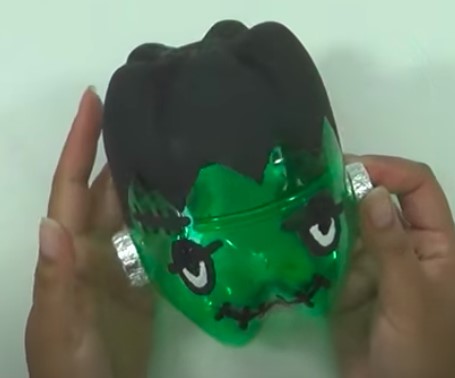
Frankenstein with recycled bottles

Take two large, empty soda bottles, cut out the bottom of each bottle and join the two parts.

On the top, paint the hair and eyes, then paint the mouth and some screws on the bottom.

Finally, take the bottle caps and wrap them in silver foil; They will look like two screws that you can stick in the bottle simulating the ears.

Source: Ecobrisa Manualidades con Reciclaje

Bats with bottles of liquid yogurt

Save the bottles of liquid yogurt you have at home and paint them black.

Also paint the occasional straws black to simulate the bat’s legs. Draw the wings on a piece of paper, paint them black, and glue them to the bottle.

Just add the eyes!

Today’s blog ends here. We hope you liked it a lot!

You can follow us on our social networks if you want to see more about us.

See you!